
Key takeaways:
- AI search visibility shifts the goal from ranking a keyword to becoming the answer an engine cites and reuses.
- Compared with traditional SEO, it rewards intent and depth over volume—prioritizing demand capture and brand authority over vanity metrics.
- Nearly half of AI Mode citations are highlighted passages, not plain links, and the passages that get reused correlate strongly with #1 rankings.
- Agencies that treat AI visibility as a core strategic lever—and measure it continuously—outperform those running it as a side experiment.
The shift from traditional SEO to AI search visibility fundamentally redefines what success looks like. Where keyword rankings once dominated the conversation, machines now reward depth, intent, and being cited as a trusted source. This isn't a minor tactical adjustment—it changes what you measure, what you chase, and what you can defend to a client. That's why AI search visibility reframes the entire conversation, and it belongs at the center of any serious approach to Seo Tracking For Ai And Search.
How do AI SEO tools compare to traditional SEO strategies in terms of results and efficiency?
Traditional SEO is built on reverse-engineering a keyword list and producing pages to match it. Ai seo solutions start from a different premise: they read intent. Rather than counting how often a phrase appears, they model the questions a buyer is actually asking, adapt as algorithms shift, and surface new opportunities faster than a manual audit ever could. Where a keyword audit answers "which phrase should we target," intent-led analysis answers "which question can we own, and will the engine trust our answer?"
The efficiency gain is real, but the results gain matters more. The old scoreboard—raw sessions, keyword counts, bounce rates—rewards motion, not meaning. AI-driven visibility moves the focus to traffic quality: are you capturing genuine demand, and are you building the authority that makes an engine cite you? Those are business outcomes, not vanity metrics. For that reason, agencies should treat it as a core strategic lever, not a side experiment bolted onto a keyword plan.
Are there any case studies or success stories showing measurable results from businesses using these AI SEO tools?
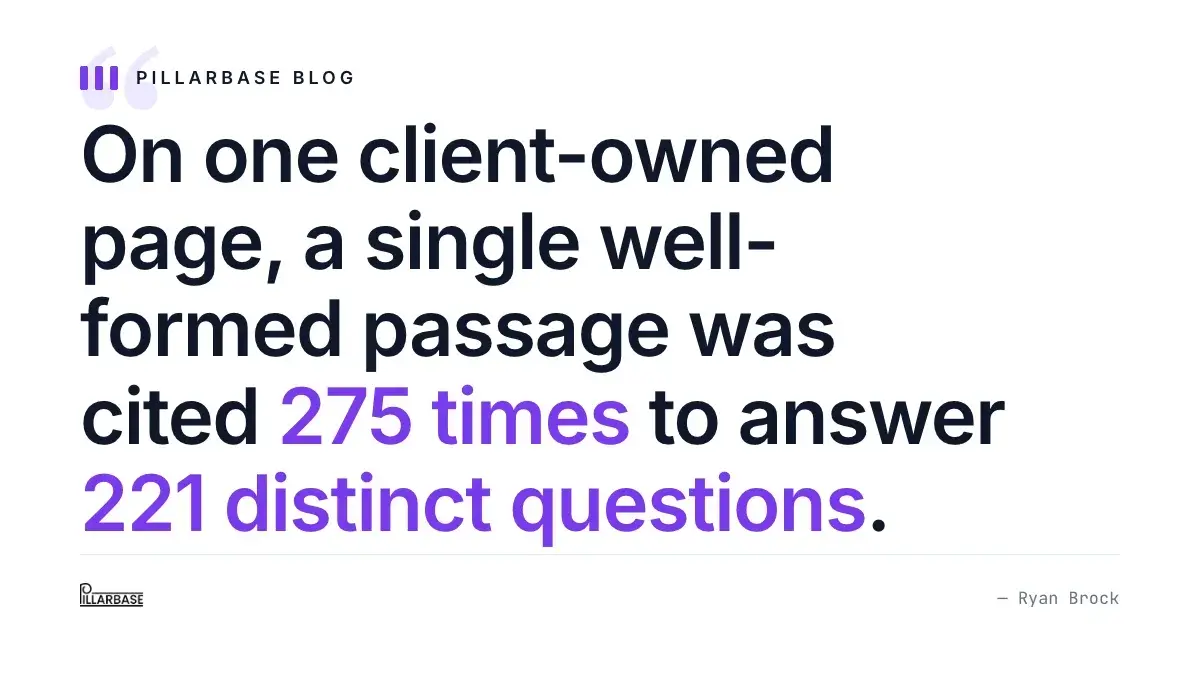
Consider a Pillarbase census of 15.7 million AI Mode citations gathered over roughly a year. Nearly half—47.7%—weren't plain links at all; they were highlighted passages the engine extracted and reused. On one client-owned page, a single well-formed passage was cited 275 times to answer 221 distinct questions. On another, one paragraph served 91 different queries from the same page. That's demand capture at a scale keyword tactics rarely reach.
A basic Website traffic checker would have missed those wins entirely, because the payoff wasn't a spike in sessions—it was a page becoming the machine's default answer across an entire cluster of buyer phrasings. The strategic difference is precision: instead of guessing at surface-level numbers, you can trace measurable brand lift back to the exact passages doing the work, which is precisely where new demand gets captured. To understand how to measure these wins systematically, see How can I measure the effectiveness of my SEO efforts specifically for AI search engines?.
How can businesses adapt their SEO strategies to stay ahead in 2026?
Staying ahead in 2026 means integrating AI visibility into the core of the marketing mix, not treating it as a tactical add-on. A few proactive moves:
- Map content to real buyer questions and the intent behind them, not to a keyword spreadsheet.
- Write passages engines can lift cleanly—clear, self-contained, quotable answers to specific questions.
- Measure continuously across both search and AI, tracking citation and reuse rather than position alone.
A conventional Google traffic Checker still earns its place for baselines, but on its own it can't tell you whether an engine is citing you or ignoring you. Ongoing measurement with tools built for this era shows the real impact on traffic quality and authority over time. The teams that win will evolve beyond keyword chasing toward holistic demand capture and brand positioning—owning the topics they're genuinely qualified to answer. For deeper guidance on implementation, explore Optimize website for AI search.
How can AI SEO tools help improve my website's Google rankings compared to traditional SEO methods?
Here's the connection most traditional methods miss: the pages that accumulate reused passages are strongly associated with #1 organic rankings. When Google finds a passage it trusts, it recycles that highlight across many queries—and the pages hosting those highlights tend to sit at the top. Ai seo solutions find those openings by optimizing content for both user intent and algorithmic shifts, then learning and adapting as the engine's behavior changes. That's precisely why a page ranking first on Google can still lose the click if the AI answer above it cites a different source, which is what makes AI visibility a leading indicator of organic performance rather than a mere byproduct of it.
That's a durable advantage over one-time optimization. Sustained, adaptive visibility doesn't just lift rankings—it compounds into higher-quality leads, stronger brand authority, and more effective demand capture. Which brings the comparison full circle: AI search visibility versus traditional SEO isn't a tooling debate, it's a decision about what your digital marketing is built to achieve.
The bottom line is that this approach doesn't replace traditional SEO so much as raise the bar it once set, pushing every part of your digital marketing toward intent, authority, and real demand. If you want to see exactly which topics you're positioned to own—and how you'd measure the win—request a full pillar report and take the next step toward smarter, data-driven visibility.