
Key takeaways:
- Tracking now spans two surfaces at once: classic page-one rankings and the citations, mentions, and answer inclusions that decide whether AI engines quote you.
- The metrics that matter are AI citations, share of voice in AI answers, and a visibility score — not search volume, domain authority, or backlink counts.
- Attribution is the hard part; separate shifts caused by AI features from those caused by core algorithm updates by segmenting your data by search experience.
- GEO, AEO, and LLMO all describe the same shift — earning inclusion in generated answers — and precise terminology keeps your reporting honest.
- A Pillarbase census of 15.7 million AI Mode citations found that 47.7% were highlighted passages rather than plain links — and the passages that get reused most skew heavily toward #1-ranked pages, so being quotable and ranking reinforce each other.
Visibility measurement has split in two. For the past twenty years, SEO tracking answered a single question: where do my pages sit on page one? That question still matters, but it no longer tells the whole story. AI-generated answers, overviews, and chat-style results now sit between your content and your audience, deciding what gets quoted long before anyone clicks a link. SEO tracking for AI and search is the discipline of measuring visibility across both of those surfaces at once — and it's the "how do you know it's working?" layer of Pillar-Based Marketing.
What methods can be used to attribute fluctuations in SEO performance specifically to AI-powered search updates versus traditional algorithm changes?
When organic results move, the instinct is to blame "an algorithm update." That instinct is now wrong at least half the time. The most useful first move is to segment your data by search experience before you touch a single ranking report. Ask a narrower question: did my blue-link position actually change, or did an AI Overview appear above my result and quietly absorb the clicks that used to reach my page? Those are two different problems with two different fixes, and conflating them wastes weeks.
To attribute a shift to AI features specifically, watch three things in parallel. First, your classic AI search ranking positions — where the page sits in the standard results. Second, whether an AI-generated answer is present for that query and whether it cites or mentions you. Third, the click-through behavior between them. If your rank held steady but traffic fell, a generative answer is the likelier culprit than a core update. If rank itself dropped across a broad set of unrelated queries in a tight window, that points to a traditional algorithm change.
This is why an AI visibility tracker belongs next to your rank data, not in a separate silo. Citations and brand mentions inside AI answers tell you whether the machine reads you as an authority — and that signal moves on a different clock than the ten blue links. The common attribution mistakes are predictable: teams lean on vanity metrics like search volume, domain authority, and backlink counts that never explained AI behavior; they report portfolio-wide traffic without segmenting by query type; and they assume every dip is punitive when, increasingly, it's an interface change — the answer moved above the fold, not your ranking down the page.
What are the most effective metrics and tools for tracking AI-driven changes in search engine algorithms impacting SEO performance?
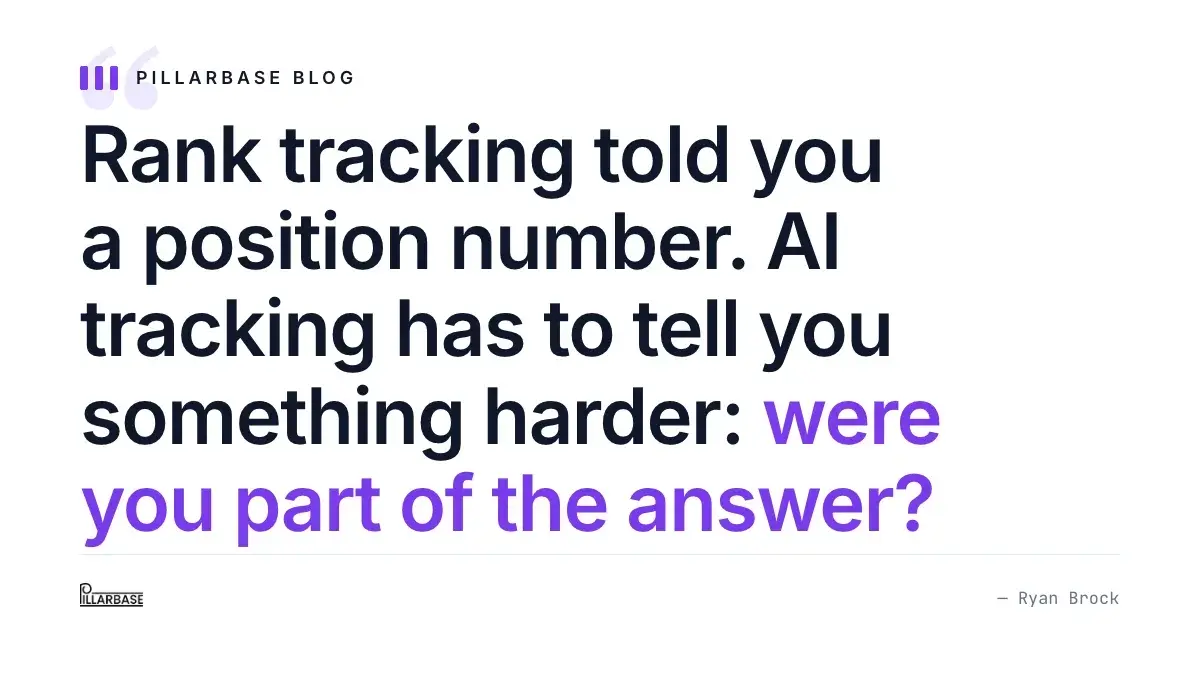
Rank tracking told you a position number. AI tracking has to tell you something harder: were you part of the answer? That reframes the metric set around three core signals. AI citations count how often engines quote or link your content inside a generated response. Share of voice in AI answers measures how much of a topic's answer space you occupy relative to everyone else. And a visibility score rolls those into a single trend line you can watch move week over week.
These are not cosmetic swaps for rank; they behave differently. A page can rank on page one and never be cited, or be cited constantly while sitting at position four. The reason to care is structural: AI engines don't just reward pages, they reward passages — the specific sentences an engine can lift out of a page and reuse in an answer. A Pillarbase census of 15.7 million AI Mode citations found that 47.7% of them weren't plain links at all; they were highlighted passages the engine pulled straight out of a page and reused. Measuring whether your sentences are the ones getting extracted is a different discipline than measuring where your URL lands.
That's the case for treating an AI visibility tracker as its own layer of measurement rather than a footnote on a rankings dashboard. For anyone running a pillar-based approach, this layer is what proves the strategy is working: it connects the topics you chose to own with hard evidence that engines now treat you as the source. Without it, you're guessing. With it, you can point to citation growth on the exact pillar topics you set out to win — which is the only version of "progress" that survives scrutiny in a client review.
How can SEO tracking strategies be adapted to monitor the influence of generative AI search features (like Google's SGE or Bing AI) on keyword rankings and organic traffic?
Adapting your tracking starts with accepting that a ranking report is now a partial view. Generative features can appear above your result, summarize your topic, and answer the query outright — so a page holding position two can lose traffic while its rank never budges. To see that, you have to track two things you may have treated as one: your keyword rankings and the organic traffic tied to those same queries, then read the gap between them.
Build the workflow to capture appearances in AI answers, not just blue-link positions. For each priority query, log whether a generative answer is present, whether your brand is named or cited inside it, and how the surrounding results shifted. Over time that record becomes an early-warning system: you'll spot the queries where the answer is eating the click before the traffic loss shows up in your monthly report.
Knowing whether you actually surface in those answers is the foundational question of AI search visibility, and it deserves its own tracking, not a footnote. The practical goal is a single, holistic view rather than two disconnected dashboards — which is exactly what the best SEO tracking for AI and search is built to deliver. A capable tool should let you sit rank movement, AI answer presence, and traffic side by side, so cause and effect stop being a guessing game. When those data sets live together, you can finally say why a number moved instead of speculating after the fact.
How do these AI SEO tracking tools actually measure visibility in AI-generated answers compared to traditional search rankings?
Traditional rank tracking works by checking a query and recording the position of your URL — a clean number, one dimension. Measuring AI visibility is messier because the unit isn't a position, it's an appearance. AI SEO tools surface visibility by parsing generated answers and logging three things: whether your domain is cited as a source, whether your brand is mentioned by name in the answer text, and whether a specific passage of yours was included or quoted.
The passage part is where this gets interesting, and where it diverges sharply from ranking. Engines don't just cite pages — they extract and recycle specific sentences. In that same census, the single most-reused passage answered 483 distinct queries, and the most-highlighted page accumulated 252 distinct variants — one well-formed paragraph becoming the machine's reusable answer to an entire cluster of questions while a neighboring page that ranks higher goes unquoted. A rank tracker will never show you that; it only knows blue-link positions.
There's a payoff to watching both. In the same census, the passages that get reused most came overwhelmingly from #1-ranked pages — 59% of high-reuse passages, rising to 76% for those reused 100 times or more. That's an association rather than a proven cause, but a strong signal that the two forms of visibility reinforce each other rather than compete. So a tool that only reports AI citations, with no tie back to classic rank, gives you half a picture; a rank tool with no citation data gives you the other half. The complete story needs both, joined at the query level, because the queries where you're cited and the queries where you rank are increasingly the ones that compound into authority.
How does optimizing for AI search differ from traditional SEO strategies I might already be using?
Traditional SEO is a game of targeting and authority: pick keywords, match intent, publish, and earn links so the algorithm trusts the page. Optimizing for AI search keeps some of that but shifts the object of the work. Instead of ranking a URL, you're trying to be recognized as an entity and included as an answer. That means writing self-contained, clearly-attributed passages a model can lift and cite, reinforcing the topics you're known for so engines associate your brand with them, and structuring content so the answer to a question sits in one clean, quotable block.
This is where the alphabet soup shows up. Three acronyms describe the same broad shift:
- GEO — Generative Engine Optimization: making your content the source that generative engines pull from when they compose an answer.
- AEO — Answer Engine Optimization: structuring content to directly answer questions so it's eligible for answer boxes and AI responses.
- LLMO — Large Language Model Optimization: shaping how large language models understand and represent your brand and expertise.
Learn any one of these and you've mostly learned the others; the differences are emphasis, not substance. What unites them is the move from ranking for keywords to earning citations and mentions inside generated content. That's a different craft — closer to being quoted by a journalist than climbing a leaderboard — and the deep tactical playbook for it lives in Optimize website for AI search. Treat it as an extension of solid fundamentals, not a replacement: the pages that earn AI citations are usually the same pages that were well-structured, genuinely useful, and topically deep to begin with.
Which tools are most effective for tracking brand mentions and sentiment within AI-powered search platforms?
When an AI engine answers a question in your category, three outcomes are possible: it names you, it names a competitor, or it names no one. Tracking which of those happens — and in what tone — is how you measure share of voice inside AI answers. Brand mentions tell you presence; sentiment tells you whether the machine frames you as the trusted option or an also-ran. Both move independently of rank, and both matter more as answers, not links, become the first thing buyers see.
An AI Rank Tracker built for this purpose watches your brand's presence across AI-powered experiences and flags when mentions rise, fall, or change tone for the topics you care about. Paired with your AI search ranking data, it answers a question rank alone can't: when the engine talks about this subject, does it bring me up, and does it speak well of me? That's the difference between being on page one and being the recommendation.
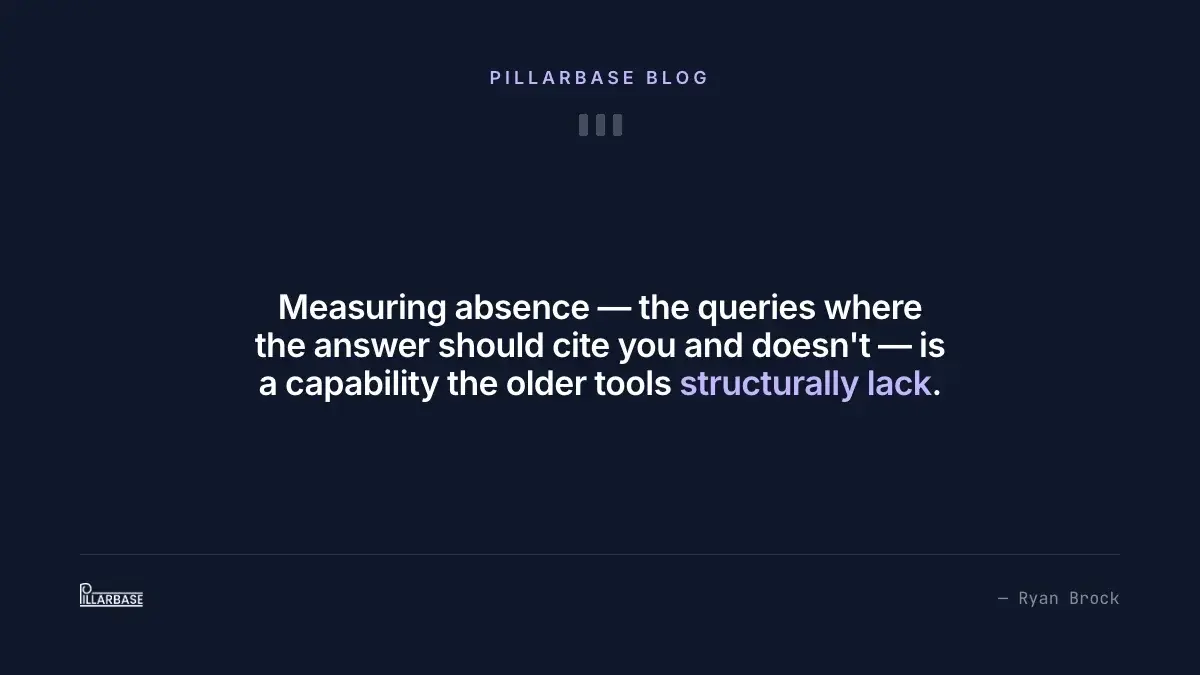
Traditional brand monitoring tools weren't built for this. They were designed to scrape social posts, news, and reviews for your name — surfaces where your brand string appears literally. AI answers are generated, paraphrased, and synthesized; your brand may be represented without an exact-match mention, or omitted from an answer where you clearly should appear. Legacy monitoring simply can't see that omission, which is often the most important signal of all. Measuring absence — the queries where the answer should cite you and doesn't — is a capability the older tools structurally lack.
Are there any tools or analytics platforms that help track and improve SEO performance specifically for AI-driven search engines?
Yes — and the useful ones share a recognizable feature set. When you evaluate a platform for AI-driven search, look for a few non-negotiables:
- Citation tracking — which queries quote or link your content inside a generated answer, and how that changes over time.
- Answer-inclusion monitoring — whether your passages appear in AI responses, not just whether your URL ranks.
- A trended AI visibility score that rolls citations, mentions, and inclusions into one number you can report against.
- A join back to classic rankings, so AI and traditional visibility live in one view instead of two.
The point of an AI search visibility tool isn't a prettier dashboard; it's a feedback loop. Good platforms don't just measure — they tell you which pages are close to earning a citation, which passages are already getting reused, and where a small structural fix could tip a near-miss into an inclusion. That turns reporting into a to-do list. Watching your visibility score climb on the specific topics you set out to own is the clearest proof that the work is landing.
This is exactly where measurement meets method. In pillar-based marketing, you deliberately choose the topics worth owning; the analytics layer is what proves you're owning them. A rigorous AI visibility audit is how you turn scattered signals into a defensible report — one you can put in front of a client and explain, repeat, and stand behind quarter after quarter, rather than hand-waving at a traffic chart.
Are there common mistakes to avoid when optimizing for AI search algorithms?
The most common mistake is inertia: pouring all your effort into traditional rankings while ignoring whether you appear in the answers now sitting above them. Rank still matters, but treating it as the only scoreboard means you can "win" the position and lose the click. The mirror-image mistake is chasing AI visibility so hard you neglect the fundamentals that earn it in the first place — the two are not a trade-off.
A short list of pitfalls worth auditing out:
- Reporting on vanity metrics — search volume, domain authority, backlink totals — that never predicted whether an engine would cite you.
- Ignoring AI answer visibility entirely because it's harder to measure than a rank number.
- Writing content in a style no model can cleanly extract — burying the answer in five hedged paragraphs instead of one quotable block.
- Optimizing once and walking away, as if AI behavior were static.
The fix is to align your work with real AI search ranking signals — citations, mentions, passage inclusion — rather than proxies, and to treat it as an ongoing practice. Answer engines change how they compose and source responses frequently, which means last quarter's winning passage can quietly stop getting cited. Regular audits catch that drift early, retire tactics that have gone stale, and keep your reporting anchored to signals that actually move buyers rather than numbers that only look good in a slide.
Is AI SEO called AEO?
Sort of — but the terms aren't interchangeable, and the distinction matters when you report. "AI SEO" is the umbrella: all the work of earning visibility in AI-influenced search. AEO, GEO, and LLMO are more specific slices of that umbrella. AEO (Answer Engine Optimization) focuses on structuring content to answer questions directly. GEO (Generative Engine Optimization) focuses on becoming a source generative engines synthesize from. LLMO (Large Language Model Optimization) focuses on how models understand and represent your brand. So AI SEO isn't only AEO — AEO is one lens within it.
Why fuss over terminology at all? Because your reporting is only as clear as your language. If a client asks whether they "rank in ChatGPT," and your team means three different things by "AI SEO," your dashboard becomes a debate instead of a decision. Precise terms let you tie a specific metric to a specific goal: citations for GEO, answer inclusion for AEO, brand representation for LLMO. That precision is what keeps a pillar-based program accountable.
So how to rank in AI search comes down to internalizing these distinctions and acting on them together: structure passages to be answer-ready (AEO), build topical depth so engines pull from you (GEO), and reinforce a consistent, well-attributed brand story so models describe you accurately (LLMO). Do all three on the topics you've chosen to own, measure each with its matching signal, and "ranking in AI search" stops being a mystery and becomes a set of levers you can actually pull.
What are some of the most effective AI SEO tools right now, and how do they actually work?
Rather than name products, it's more useful to understand what the effective ones do — because the category moves fast and features matter more than logos. The strongest AI SEO tools converge on three core functions. First, they track citations at scale, continuously querying answer engines and recording when your content is quoted or linked. Second, they monitor answer inclusion — detecting when your passages appear inside generated responses, and which passages earn that reuse. Third, they measure and trend overall visibility, so a fuzzy question ("are we showing up in AI answers?") becomes a number you can watch and defend.
Under the hood, this works by sampling real queries, capturing the generated answers and their cited sources, matching those sources back to your domain and brand, and then joining that data to classic rank so both surfaces sit in one report. The output isn't just a score — it's a set of actions: the passages already getting recycled (protect and expand them), the near-misses (tighten the structure), and the topics where you're absent (build the coverage).
For a pillar-based program, that's the whole value: actionable insight across both traditional and AI search, tied to the topics you deliberately set out to own. It's why a platform like Pillarbase treats AI citations and page-one rankings as one connected story rather than two reports. Choosing the best SEO reporting tools for agencies isn't about the flashiest interface — it's about a system that turns measurement into citation growth on the topics that actually move your business.
The takeaway is simple even if the execution isn't: tracking is the layer that proves your content strategy is working, and that layer now has to span both classic rankings and AI answers. Watch citations, mentions, and answer inclusion alongside your positions, keep your terminology precise, and audit often enough to catch the drift. If you want to see which pillar topics you're genuinely positioned to own — across both search and AI — request a full report on your topic and put real data behind your next move.